THE AREAS OF THE CONSORTIUM

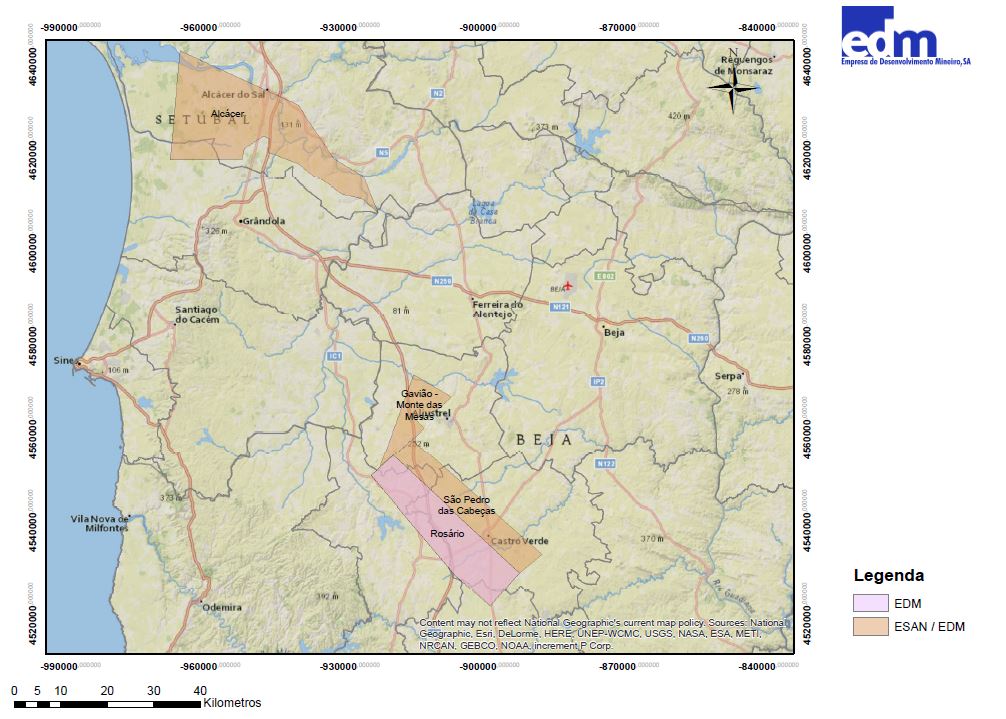
The Monte das Mesas concession for prospecting and research is located in the NW part of the Messejana fault. The favourable geostructural background of the occurrence of polymetallic massive sulphides, as well as the existence of geophysical anomalies detected during the various prospecting programmes, led to increased interest in this area, which is why it was decided to gain further knowledge of the area to the NNE of the Gavião concession and consequently find out whether there are mineral deposits that may be explored.

The prospecting and research agreement relating to the Alcácer area was signed by ESANMET, a company 100% owned by ESAN, on 23 November 2016, with the Portuguese State.

It has a surface area of 344.33 km2 and is located in the municipalities of Alcácer do Sal and Grândola, in the district of Setúbal.

The surface geology that is observed in this area is dominated by the Tertiary sediments from the Sado Basin, which cover with variable thickness the Paleozoic rocks of the Iberian Pyrite Belt (FPI) and rocks of the Mértola formation of the Baixo Alentejo Flysch Group (BAFG). In this area some “windows” have been identified where Paleozoic rocks can be observed, particularly the windows of Valverde and Pedrogão, among others.

The prospecting and research agreement relating to the São Pedro das Cabeças area was signed by ESANMET, a company 100% owned by ESAN, on 23 November 2016, with the Portuguese State. It has a surface area of 133,175 km2 and is located in the municipalities of Castro Verde, Ourique and Aljustrel, in the district of Beja.

The potential of this area lies in the fact that it is a parallel structure very close to the Neves Corvo-Rosário antiform where the Neves Corvo Mine, and several other historical holdings for copper and manganese, are located. The structure of Castro Verde is little known in depth, as only 7 mechanical probings have been carried out, and some geophysical anomalies that require further investigation have been identified.

Location of the areas
Monte das Mesas

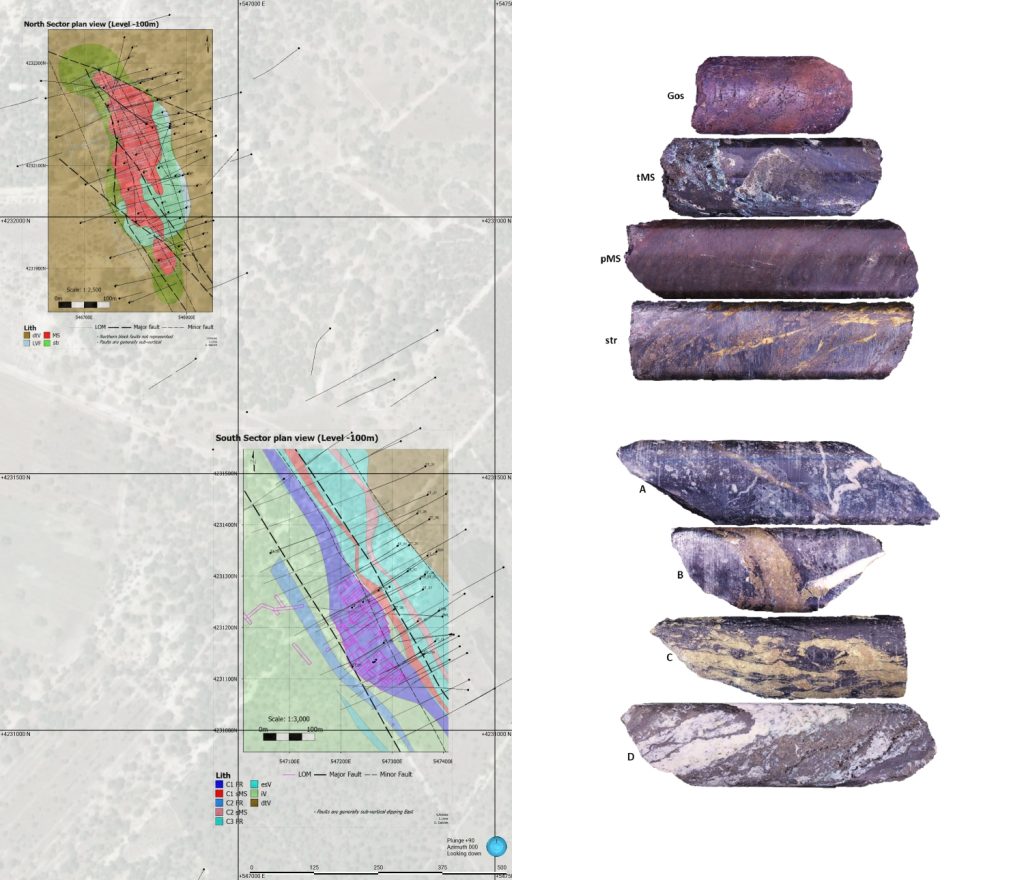
Figure 1 – Location of the two main sectors (north and south) of the Lagoa Salgada polymetallic massive sulphide deposit on the left. Drill core samples illustrating the various types of mineralization present in the northern sector (Gos – Gossan; tMS – Transition Massive Sulphide; pMS – Primary Massive Sulphide; str- Stringer) and in the southern sector (A and B – Remobilized and fissural mineralization cutting late quartz veins; C – Remobilized and fissural mineralization cutting stratification with mineralization; D – Example of Semi Massive Sulphides).

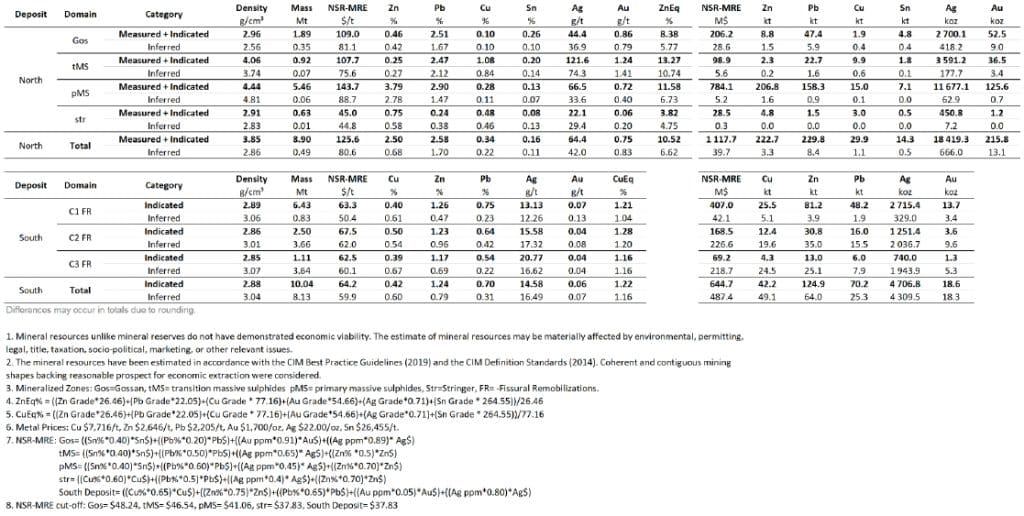
The most recent Definitive Feasibility Study (2023) indicates total mineral resources of 27.56 million tons.

Table 1 – NI 43-101 Lagoa Salgada Mineral Resource Estimate (2023). Source: NI 43-101 Technical Report and DFS for the Lagoa Salgada Project (2023), Quadrante Engenharia

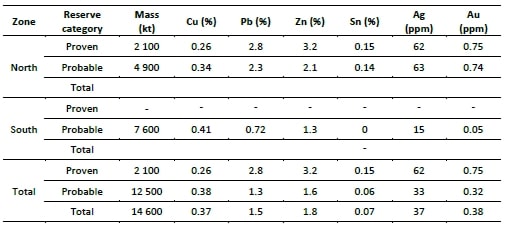
Mineral reserves, indicated in the same study, total 14.6 million tons, with 0.37% Cu and 1.84% Zn.

Table 2 – NI 43-101 Lagoa Salgada Mineral Reserve Estimate (2023). Source: NI 43-101 Technical Report and DFS for the Lagoa Salgada Project (2023), Quadrante Engenharia

This project is owned by the consortium EDM – Empresa de Desenvolvimento Mineiro & Redcorp, in which EDM has a 15% stake and Redcorp owns 85%. In turn, Redcorp is 80% owned by Ascendant Resources Inc. and 20% by the investment fund Mineral & Financial Investments Ltd. The consortium agreement between EDM and Redcorp was signed in September 2013. Ascendant Resources, based in Toronto (Canada), is focused on developing the Lagoa Salgada mining project, which aims to extract copper, lead, zinc, tin, gold and silver ores underground.

In 2022, this project was considered a PIN project (Project of National Interest), a status granted by the Portuguese Investment and Foreign Trade Agency (AICEP), making it the first mining project to gain this status in Portugal.

HISTORICAL BACKGROUND

The discovery of the Gavião deposit in 1970 was a novelty in the Portuguese mining industry, and a precursor to the increased potential of the “Portuguese” pyrite belt that has been observed. It was a first sign of what is yet to develop in this metallogenic province, proven thereafter until the present situation.

This deposit was identified in the area of Aljustrel through 62 probings (a total of 19,555.34 metres drilled), by the then Sociedade Mineira de Santiago SMS, the predecessor of EDM.

Numerous mining exploration works were carried out in this area, in particular various geophysical survey campaigns (gravimetric, electromagnetic, magnetic and electric analysis), geochemical surveys and various drilling campaigns, most importantly those held in 2012 and 2013, together with Almina, which increased the degree of confidence with regard to the distribution of content and the extent of mineralization at depth.

So far a total of 101 drilling surveys have been carried out, with 37,764.29 metres drilled.

Location of the drilling and mineralized masses of the Gavião
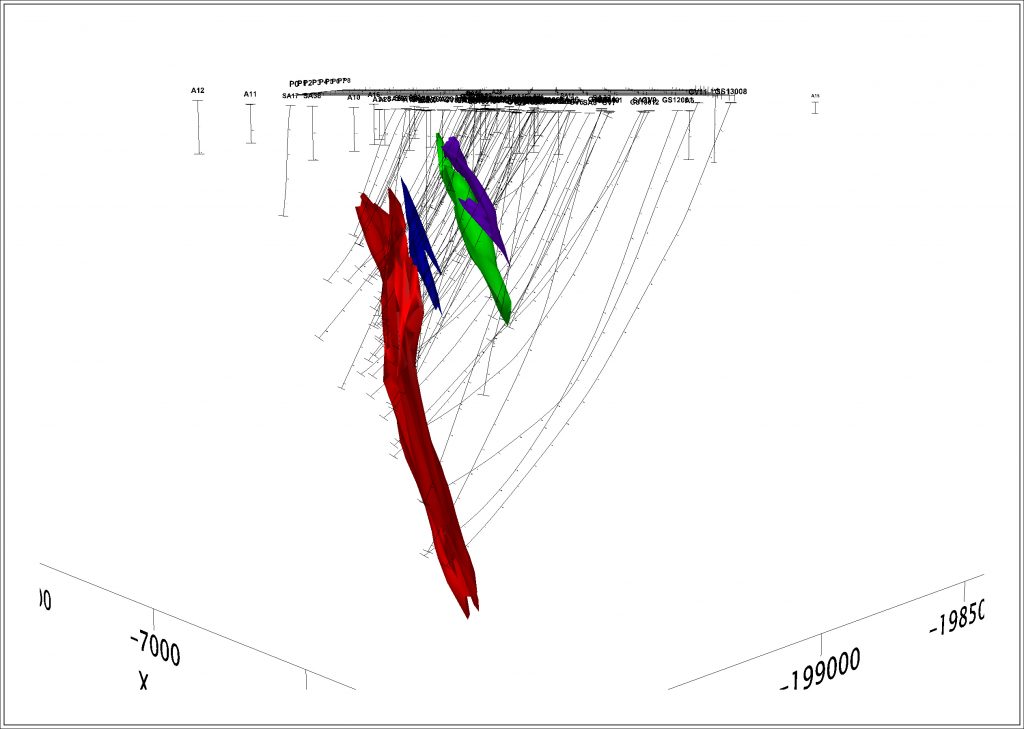
3D modeling of the mineral deposits of the Gavião deposit, based on the intersections of probings
3D Geological Modelling of the Gavião (without Tertiary cover)
GEOLOGICAL BACKGROUND

The geological sequence of the Gavião is interpreted as corresponding to the continuation of the mineralized Algares-Moinho-São João volcanic axis to the NW of the Messejana fault, having been rejected by this structure to the SW.

The mineralization of the Gavião forms part of the geology of the Aljustrel region and is characterized by the same major lithostratigraphic units of this area, and which are also known widely in the Iberian Pyrite Belt (IPB). The IPB is one of the most important metallogenetic provinces in the world for deposits of base metal massive sulphides associated with volcanic and sedimentary rocks, extending between Grândola and Seville, along a strip around 250 km long and 60 km wide, which equals an area of approximately 12,500 km2.

The main geological units of the IPB are aged between the Upper Devonian and Carboniferous periods and may be summarized as follows:

  • Phyllite-Quartzitic Group (PQ) – (Middle Devonian – Upper Devonian) is represented by a sedimentary sequence consisting of phyllites and quartzites at the top, with local levels of limestones and siltstones.
  • Volcano-Sedimentary Complex (CVS) – (Upper Devonian – Middle Carboniferous) consists of a bimodal volcanic sequence of several acidic volcanic units, of an effusive and explosive nature, and in lower number, of basic units. These volcanic rocks occur interspersed in a sedimentary sequence of varying composition where various geological formations are individualized. The massive sulphide mineralizations occur associated with the acidic volcanic rocks and black shales occurring in the vicinity of these volcanic centres.

On the units of the IPB the Flysch do Baixo Alentejo group occurs, which in the Gavião zone is represented by the Mértola formation (Middle Carboniferous) this being formed by a turbidite sequence consisting of shale, greywackes and some conglomerates.

The geological units of Paleozoic age were subjected to tectonic forces that originated sequences of tight anticline and syncline folds lying in a NW-SE direction and vergency to the SW, sometimes presenting rupture of the inverse flanks and overthrust and/or transport of sediment load. The mineralized sulphides are affected by this folding and may also be transported or overthrusting more recent geological units.

In the Aljustrel sector, all these geological units have also been fractured by the Messejana Fault, in a NE-SW direction, which caused a throw of around 2.6 km to the SW, and also the subsidence of its block to the NW. This block is currently covered by tertiary and recent deposits consisting mainly of conglomerates, clayey sandstone, sand and gravel. In fact, this fault corresponds to an area where there are several parallel faults and it has as a conjugated system of faults in a N-S direction with movement of direct separation, of which we highlight the Represa, Castelo and Cerro Calvo fault.

Geophysical surveys of the “Mise à la Masse” kind show the existence of an electrical conductor with a NW-SE orientation, which coincides generally with the position of the SW mass. This conductor extends to the NW of the mineralization known through probings suggesting that this may extend in that direction and also to the SE, towards the Messejana fault, arching to the E in the proximity of the structure. This camber is in line with the counterclockwise movement of the Messejana fault, similar to what happens with the mass of São João in another block of the same fault. The NE mass is also correlated with a conductor evidenced by the same method, which suggests the continuation of this mass to the Messejana fault, which may correspond to the mineralization intercepted in the SA25A probing.

The mineralization of the Gavião consists essentially of pyrite with different proportions of chalcopyrite, sphalerite and galena. Other sulphides also occur in lesser amounts, such as arsenopyrite, tennantite-tetrahedrite and pyrrhotite. The mineralization generally has a fine to very fine-grained texture and is associated with acid volcanic rocks, called Tufo de Mina and with black shales of the Gavião Formation.

REGIONAL GEOLOGY

The exploration area is in the southwest sector of the Central Iberian Zone near the contact point with the Ossa Morena Zone and belongs to the Góis-Segura stannous-tungstiferous metallogenic belt. This strip has an area of approximately 8,000 km2 and is known to possess large deposits which gave rise to the mines of Panasqueira (W-Sn-Cu), Argemela (Sn), Segura (W-Sn-Pb) and Góis (W-Sn).

The Góis region is located in the Serra da Lousã and is marked by steep reliefs, among which the Penedos de Góis are particularly notable. These reliefs consist of quartzite ridges dating back to the Ordovician period which belong to the Armorican Quartzite Formation, and reach an altitude of around 1,043 metres. The Penedos de Góis are hard land forms, rather elongated in a N30ºW direction. These reliefs are embedded in older schist and greywackes belonging to the Schist Greywacke complex of the Beiras Group, which dates back to the Neoproterozoic era, where the two previous lithologies predominate but conglomeratic levels also occur. The Schist Greywacke Complex is divided in this region into three formations, which bottom-up are: The Caneiro Formation, the Boque Serpins Formation and the Colmeal Formation.

To the northwest, the Schist Greywacke Complex is separated from sedimentary deposits of the Cretaceous to the Quaternary by the Góis fault. This fault, which runs in a NE-SW direction, is the main structure of the region and now has an inverse movement that causes the thrust of the older Schist Greywacke Complex over the more recent Meso-Cenozoic units.

The folding in the region is fairly well demonstrated across the whole area, anticlines and synclines being visible in a NW-SE direction corresponding to the 3rd stage of variscan deformation and associated cleavage. Several faults in dominant directions NNE-SSW, N-S and NE-SW occur in the area and may present locally significant fills of quartz.

HISTORICAL BACKGROUND

Throughout the exploration area there are various known mineral deposits of Sn-W and Au-Ag(Sb), many of which are being mined on different scales.

The deposits and former Sn-W mines are located mainly in the NW sector of the exploration area and belonged to the Góis mining field. Mining in this metallogenic province reached its peak during World War II, the tungstiferous zone being the most productive area of Portugal at that time.

In 1957, the Góis Mining Field was founded with around seventeen concessions, including the Vale de Pião and Sandinha (Senhora da Guia Mine) concessions, which correspond to the most important tin and tungsten mines, respectively. The Senhora da Guia Mine operated between 1949 and 1972. During this period 8 levels of galleries were opened over a distance of 350 m and reaching a depth of 126 m. The operations focused on sub-vertical quartz veins with tungstiferous mineralization. The Vale Pião mine operated between 1946 and 1969 and mined sub-horizontal quartz veins, predominantly stanniferous mineralization. After the closure of the mine in the 1980s, the SFM carried out a prospecting campaign in which 25 surveys were conducted covering the area of the mining works and its surroundings, drilling a total of 3,200 metres.

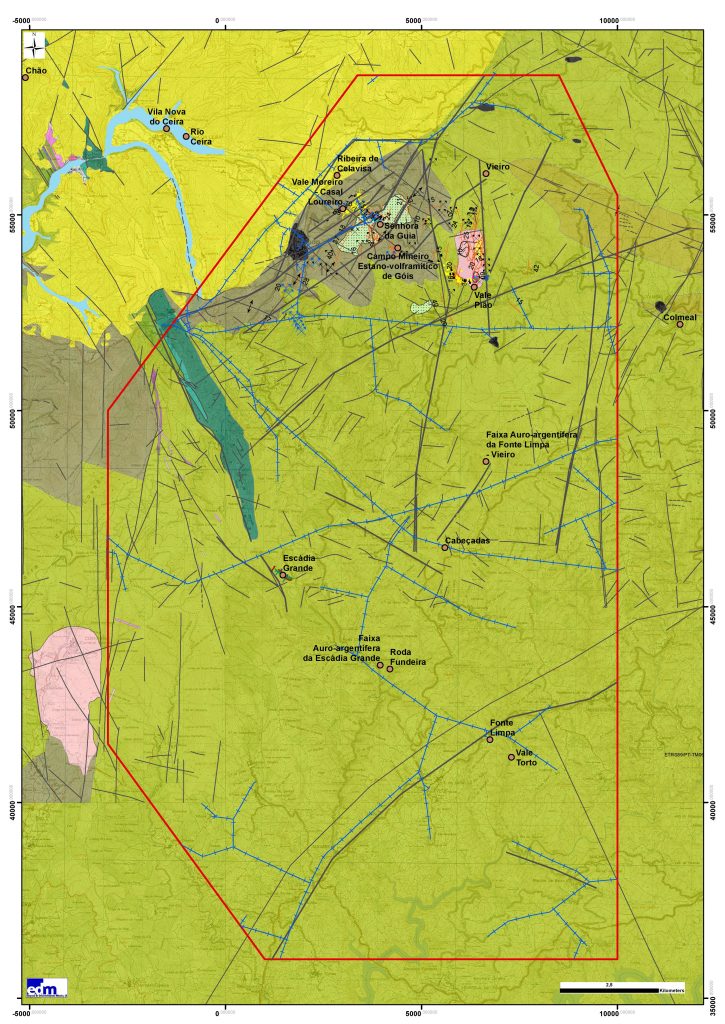
Geological background of the Escádia Grande area
Mineralização estano-tungstífera

The stannous-tungstiferous mineralizations mainly occur at the N-NW zone of the exploration area and are associated with non-outcrop granitic intrusions.

The mineralizations of Sn-W occur in two types of structures: veins and breccias/stockworks.

The vein structures, generally of a NW-SE direction, are characterized by quartzose filling with cassiterite, wolframite and, more rarely, scheelite. These may be sub-vertical and sub-horizontal, both lying in a general NW-SE direction. They have thicknesses not exceed 0.60 m and as well as the useful mineralization, they also contain sulphides (arsenopyrite, pyrite, sphalerite, pyrrhotite, chalcopyrite), mica, tourmaline and apatite. The Senhora da Guia Mine (W) essentially mined sub-vertical veins with wolframite. The Vale Pião Mine (Sn) mined sub-horizontal quartz veins, predominantly cassiterite and some wolframite.

The structures of the type breccia/stockwork are identified in two places: in the former Vale Pião Mine and the Vale Moreiro – Casal Loureiro sector. Installed in late Variscan to alpine shear zones (NNE-SSW), these structures have essentially tungstiferous, and to a lesser extent, stanniferous mineralization.

Geology and location of former mines of Senhora da Guia (W) and Vale Pião (Sn-W) and Vale Moreiro – Casal Loureiro sector
Auriferous mineralization

The auriferous mineralizations are associated with quartz vein structures and sulphides that occur in NW-SE shear zones.

At the Escádia Grande mine, auriferous mineralization occurs in vein structures of tabular and lenticular morphology in the general direction of N30º-55ºW, variable pitch of between 50º-60ºSW and thickness of between 0.50 to 0.70 m. The vein structures exhibit essentially quartzose filling with arsenopyrite strongly associated with the auriferous mineralization, but also other sulphides (galena, sphalerite, pyrite) and chlorite. This deposit is affected by faults in NNE-SSE and ENE-WSW directions, making significant tailings, in particular horizontal, which displace the mineralized structure.

The area of Vale Pião was also mined by the Romans for gold. In this sector, breccia were identified in a NNE-SSW direction with quartz and sulphides that may be the carrier structures of the auriferous mineralization.

Geology and former mining operations of Escádia Grande mine
Geological background

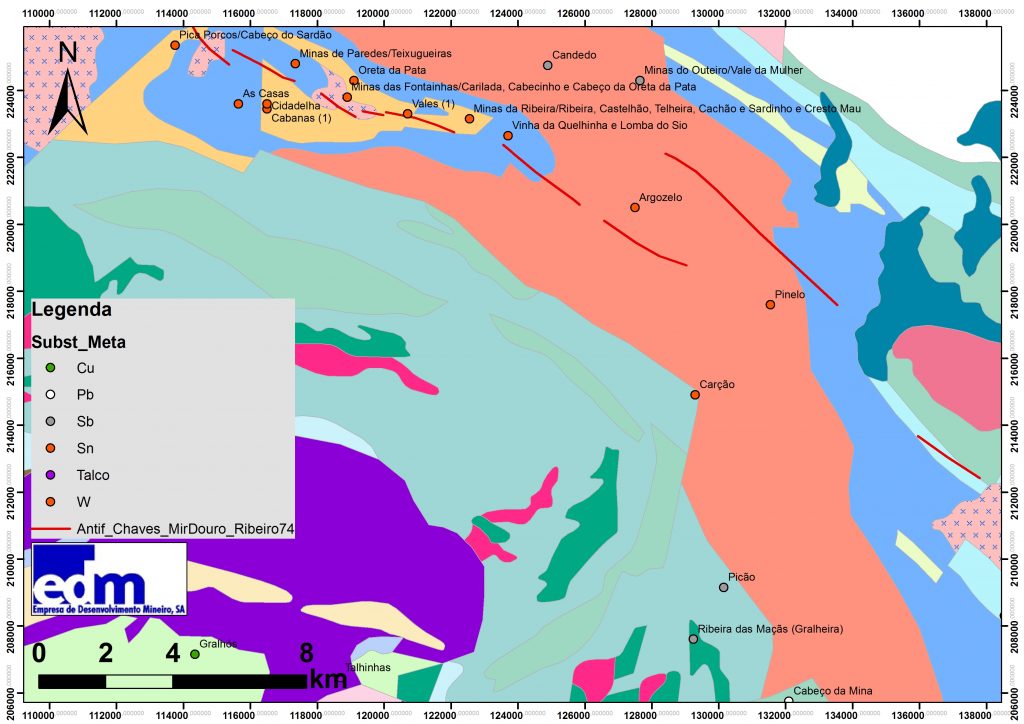
The Argozelo area belongs to the Galiza Média Trás-os-Montes Zone (ZGMTM – Parautochthonous) at the southern edge of the Peritransmontano group, in the region of the Chaves – Miranda do Douro antiform. This sector includes rocks from the Silurian age belonging to the Upper Quartzite Formation (schist quartzite and quartz phyllites) and the Upper Schist Formation (siliceous and carbonaceous grey schists and siltstone), as well as from the Devonian age, represented by the Culminant Schists and Greywackes Formation (alternation of millimetric pelites and siltstones and quartz wacke). The entire sequence was affected by the Hercynian orogenesis through various stages of deformation, with the installation of syntectonic to late tectonic granitoid masses also occurring during this period.

The mineralization associated with this Argozelo sector essentially comprises quartz vein structures with sulphide mineralization and tin (Sn) and tungsten (W) association. Occurrences of gold (Au) are also found in this sector related to the late Variscan phases (ductile-brittle to brittle) and which developed systems of fractures in a principal NNE-SSW direction that control the installation sulphide quartz vein structures with the possible presence of gold. These alignments are parallel to the great Régua-Verín and Vilariça faults).

In the Argozelo area, several styles of mineralization are identified. These are distinguished by volume, age, type of mineralization, mineralization bearing structures and mineralization processes. Generally cassiterite, wolframite and scheelite occur in a complex network of sub-vertical quartz veins, but also in hydraulic breccias, disseminated in greisen, and, possibly, the occurrence of scheelite disseminated in calc-silicate zones associated with Silurian formations.

Geology of the Argozelo sector
HISTORICAL BASIS AND FIRST RESULTS FOR EDM

Within the Argozelo area, there are several former mines where tungsten and tin ores were extracted from the nineteenth century to the 1980s. The most important were the mines of Paredes, Ribeira and Argozelo.

Paredes mine consists of small open pit excavations and galleries in a greisen with cassiterite and quartz veins (N30ºE, N30ºW) with cassiterite, wolframite and various sulphides.

The Ribeira mine closed in 1986. Four levels of galleries were mined to a depth of 140 m, with the galleries extending for more than 500 m. The mineralization of tin and tungsten occurs in a system of quartz veins running NW-SE.

Further to the SE of the former Ribeira mines lies the channel sector of the Sabor river, which demonstrates potential for having mineralized veins in N20º-45ºW direction and an average inclination of 75ºSW, similar to those mined intensively in the former Ribeira mine. As in the former mines of Ribeira, the presence of a greisenized granite dome (with lithogeochemical results of 0.09% Sn and 0.01% W) was observed at relatively shallow depths and close to the quartz veins, with the lithogeochemical results showing values of 0.18% Sn and 0.01% W. This sector takes on added importance as the Silurian calc-silicate geological units occur herein, which may contain scheelite.

The Argozelo mine, the most important in the area, was in production between 1889 and 1984, with mining galleries distributed over 7 levels at a depth of 170 m.

The SFM (Mining Development Service) conducted various studies that identified possible reserves of 0.6-0.7 Mt of ore on floors 6 and 7 and a possible floor 8, which has not been explored. These reconnaissance works indicate the continuity of the mineralized structures below floor 7 with high Sn and W contents.

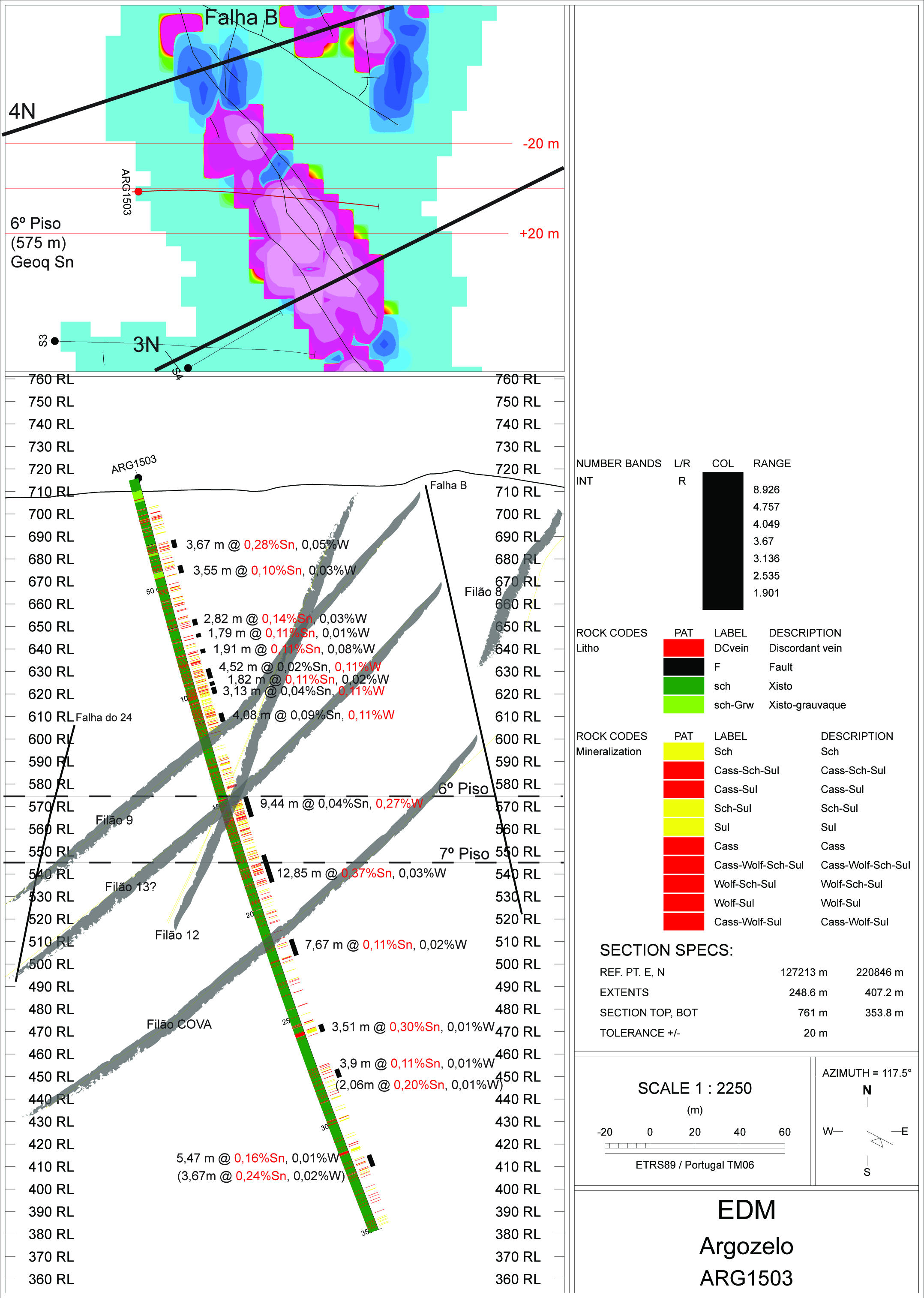
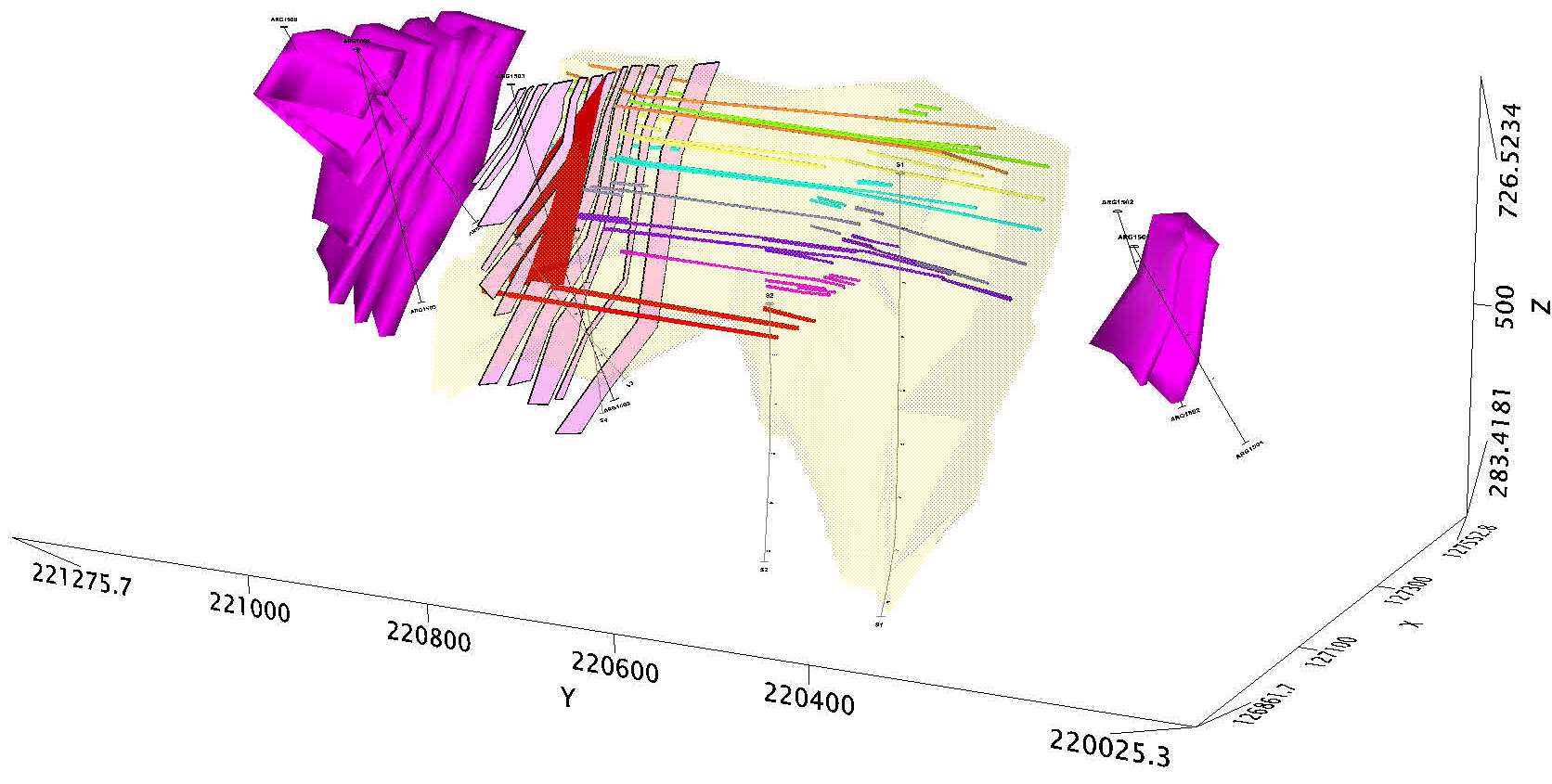
With these indications, EDM undertook prospecting and research work in the Argozelo sector that allowed the evaluation and confirmation of the lateral extension and depth of the mineralized structure of Argozelo. The work carried out consisted of: i) detailed geological and structural mapping indicating mineralized structures lying in a N-S direction at N70ºE and W-NW inclinations; ii) petrographic studies of lithotypes and mineralizations in thin sections; iii) geochemistry campaigns for soil (that indicated maximum values of 576 ppm W and 238 ppm Sn) and rock (with maximum values of 1.82% Sn and 0.97% W); iv) geophysical surveys (IP) that showed that the lateral extension of the vein zone of Argozelo; v) opening of ditches along the veins of Argozelo; vi) 6 surveys over a total of 1,567 m and sampling of probings for geochemical analysis. The geochemical data from the soils and rock were also processed geostatistically, and geochemical modelling of Sn and W was performed on floors 6 and 7 and the former galleries of mineralized veins and the mineralization envelope of Argozelo mine.

The analytical values of the samples of the probing from Argozelo show levels of SnO2 (max. 10.2%) and WO3 (max. 1.92%) which, associated with levels of Ca (max. 5.29%), reflect the presence of the main mineralogy of this ore deposit (cassiterite, wolframite and scheelite). The ancillary sulphide mineralogy regularly present in the mineralized structures stands out in the analytical values of Cu ≤15,500 ppm, Zn ≤18,200 ppm, As ≤51,700 ppm and Ag ≤50.5 ppm.

Section of the projection of probing ARG1503, indicating the veins, the thickness and the Sn and W content of the richest intervals
3D modelling of the Argozelo mine mineralization envelope, lateral extensions and depth of the vein zone
Mineral paragenesis present in the quartz veins intersected in the Argozelo probings: A – Quartz vein with wolframite and sulphides; B – Breccia with cassiterite; C – Quartz vein with scheelite; D – Quartz vein with cassiterite
Skip to content